How WebHotel.cloud works
WebHotel.cloud is a self-service cloud hosting platform. A customer signs up, tests the fair-use Proxmox compute option where eligible, or saves a card and loads $5 to unlock compute, storage, databases, DNS, and other cloud services from one dashboard. Every service exposes setup details, credentials, billing mode, usage, and lifecycle actions in the customer panel.
1. Register
Users can register with Google or email/password. New signups land on the fixed welcome page so marketing conversion tracking can measure successful registrations.
2. Fund or trial
New accounts can choose one eligible Proxmox service priced at $13/month or less free for up to 3 days. Vultr and Azure require paid activation. Saving a credit card and loading at least $5 unlocks the complete catalog.
3. Deploy
Each product page guides the user through naming, region or plan selection, credentials, billing mode, and provisioning-time acknowledgement.
The user dashboard
The dashboard is the customer's command center. It shows wallet credit, billing state, linked sign-in methods, desktop app status, active services, product navigation, and quick deployment links. The left sidebar keeps services grouped by product so users can find Compute, Object Storage, PostgreSQL, DNS, Pages, Backups, Blueprints, billing, transactions, and support.
Service Center
A single place to see all live services across products. Users can review assigned resources, service names, billing mode, status, and available actions.
Transaction Log
Wallet debits, credits, Stripe top-ups, monthly charges, hourly usage, overages, and admin adjustments are shown as financial history.
Support
Users can request help without guessing which provider is underneath. WebHotel owns the customer relationship and hides upstream complexity.
Desktop App
The Windows app mirrors the web dashboard and gives users a native route into services, billing, provisioning logs, and updates.
Live products and what they do
Compute Instances
Compute Instances are virtual servers used for websites, apps, APIs, development environments, game servers, automation, and OpenClaw application hosting.
- Users choose a plan, hostname, billing mode, root password, and optional secondary sudo/admin user where supported.
- Provisioning shows clear milestones such as clone, boot, network assignment, setup, and final service availability.
- Each instance displays IP address, hostname, plan resources, status, node or region, and action buttons.
- New accounts can choose one eligible Proxmox service priced at $13/month or less free for up to 3 days. Vultr and Azure require paid activation. A saved card and at least $5 paid top-up unlocks the complete catalog.
Ceph NVMe Object Storage
Object Storage is S3-compatible storage designed for applications, websites, backups, media pipelines, and tools that speak the S3 API. It is the faster storage product because it is backed by Ceph NVMe clusters on a 10Gbps network.
- Users receive endpoint, bucket name, access key, secret key, and setup examples.
- Apps that cannot use bucket-prefixed hostnames can use path-style endpoint examples.
- Object Storage is the best choice for app/API workloads that need faster response and S3 tooling.
- Credentials can be copied from the panel and rotated where supported.
PostgreSQL Databases
Managed PostgreSQL gives users database hosting without having to administer the PostgreSQL server themselves. The dashboard shows all connection details needed by applications.
- Starter plans are for one database; Pro plans can hold multiple databases under the purchased service.
- Users see host, port, database name, username, password, SSL mode, and full connection URI.
- Passwords are hidden by default and can be revealed or changed from the control panel.
- Free 30-day PostgreSQL trials can require a Stripe billing method so the trial can convert cleanly.
DNS Management
DNS is free during beta and makes domain setup easier for non-technical users. The DNS page focuses on the fields required by WebHotel's DNS provider and hides confusing advanced fields unless needed.
- Users can create DNS zones and records with guided explanations.
- Nameservers are shown clearly so domain owners know what to set at their registrar.
- Presets help point root domains, www records, and common email providers.
- Manual refresh and propagation status reduce confusion while DNS changes spread globally.
Proxmox Backup Server
Eligible Proxmox Compute instances can add nightly off-host PBS protection from $2 per month per instance, with premium 30-, 60-, and 90-day retention. Azure and Vultr Compute instances are not eligible.
- The Backup & Recovery Center makes protection, restore points, recovery jobs, and team policies available in four simple tabs.
- Important restore points can be pinned against pruning, browsed at file level, and downloaded directly from PBS.
- A full restore always creates a new VMID and hardware identity, starts stopped, removes every network adapter, and never overwrites the original VM.
- QEMU guest-agent freeze/thaw can provide application-consistent backups; scheduled restore canaries and quarterly DR drills prove that archives can be recovered and cleaned up.
- Cross-cluster restores are validated against shared-PBS visibility and serialized to prevent conflicting restore work.
- Live progress reports provider stage, percentage, throughput, ETA, and final verification evidence.
- Customer teams can save a policy and activate matching retention and verification across several authorized instances in one action.
Pages, Workers, Blueprints, Credentials, and API
WebHotel also includes support surfaces for static deployments, automation, reusable deployment templates, credential management, and developer API access.
- Blueprints let users save repeatable deployment profiles.
- Credentials centralize secret visibility and rotation options.
- The developer API is published at /api-docs with raw OpenAPI at /openapi.json.
Wallet, Stripe, hourly, monthly, 3-month, and annual billing
WebHotel uses wallet-first billing. Charges are deducted from wallet credit. If the wallet does not have enough funds and the user has a saved Stripe card, WebHotel can deduct the wallet balance first and charge the shortfall through Stripe. This keeps services online and creates a smoother conversion path from trial to paid usage.
| Billing mode | How it works | Schedule | Display |
|---|---|---|---|
| Hourly | Usage accrues while the service remains active. Some resources have a minimum initial hourly block. | Hourly | Shown as the listed hourly rate. |
| Monthly | The first month is charged immediately in advance, then renews every 30 days. | Monthly | Shown as the listed monthly rate. |
| 3-month | The user pays three months upfront where this option is available. | 3-month prepaid | Shown as the listed upfront amount. |
| Annual | Standard Ubuntu Compute plans can be prepaid for one year at 10% below twelve monthly payments. | Annual prepaid | Shown as the annual upfront amount and effective monthly rate. |
| Overage | Storage overage is charged when measured usage exceeds the plan limit. | Usage-based | Shown from the configured overage rate. |
Example: if a monthly plan is $3.95, the 3-month option is $3.95 x 3 x 0.90 = $10.665, normally rounded for billing display. The discount is calculated from the admin-set monthly product price.
Screenshots from a fresh account
These screenshots were captured from a newly created documentation account to show prospects what the service looks like after registration.

Welcome page
Fixed registration-complete page for conversion tracking and first-login guidance.
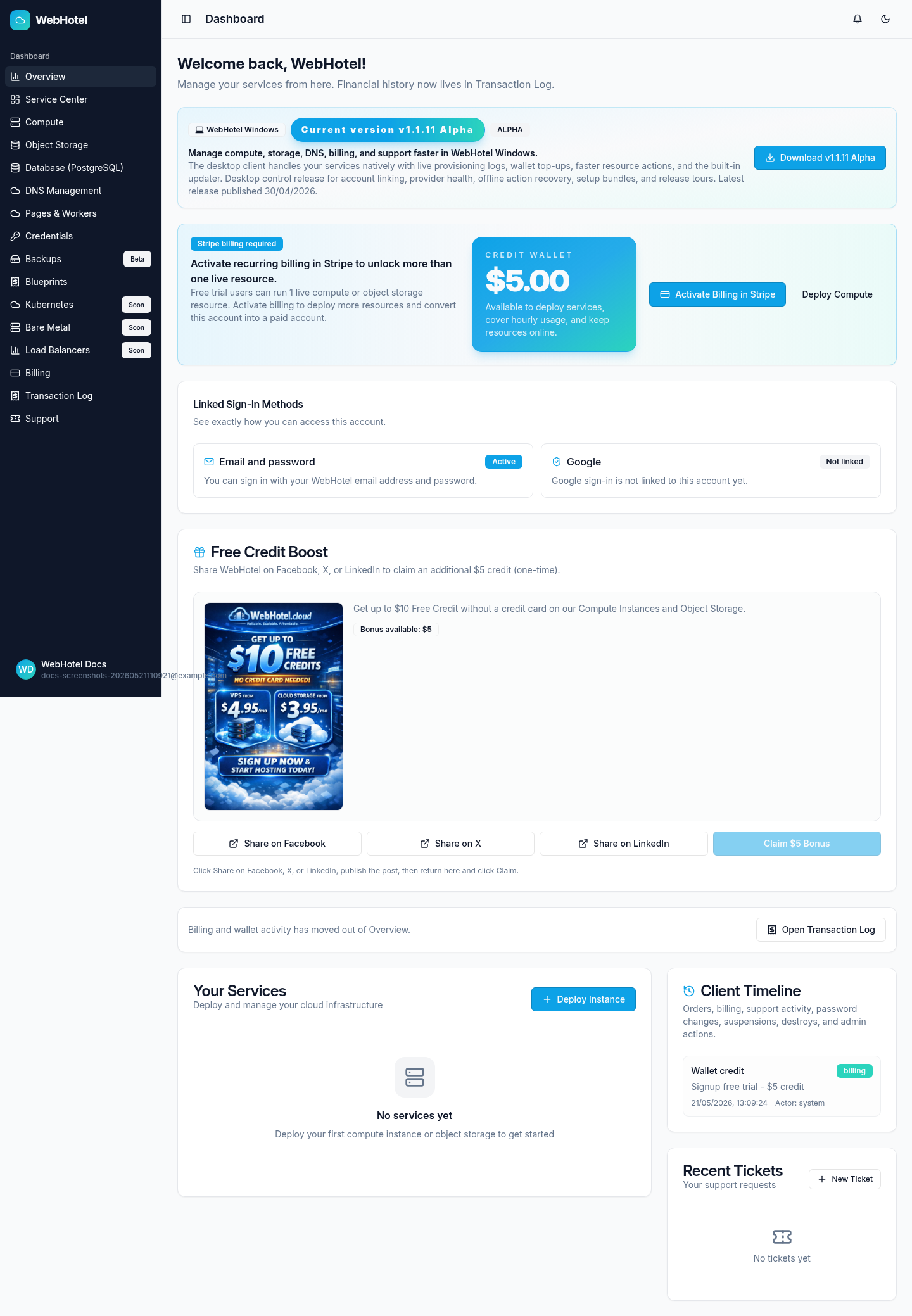
Dashboard
Wallet, billing state, navigation, desktop app, and service summary.

Compute
Plans, regions, resources, and deployment controls.
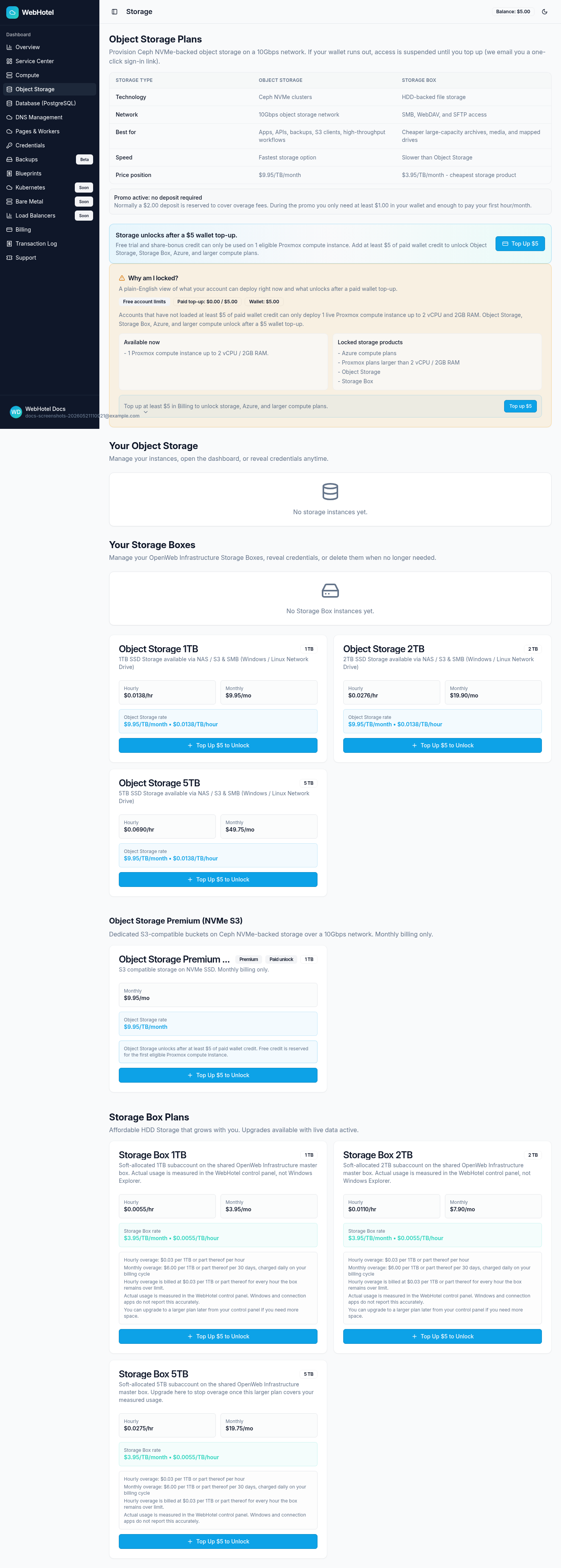
Storage
Object Storage plans, price per TB, usage, and upgrades.
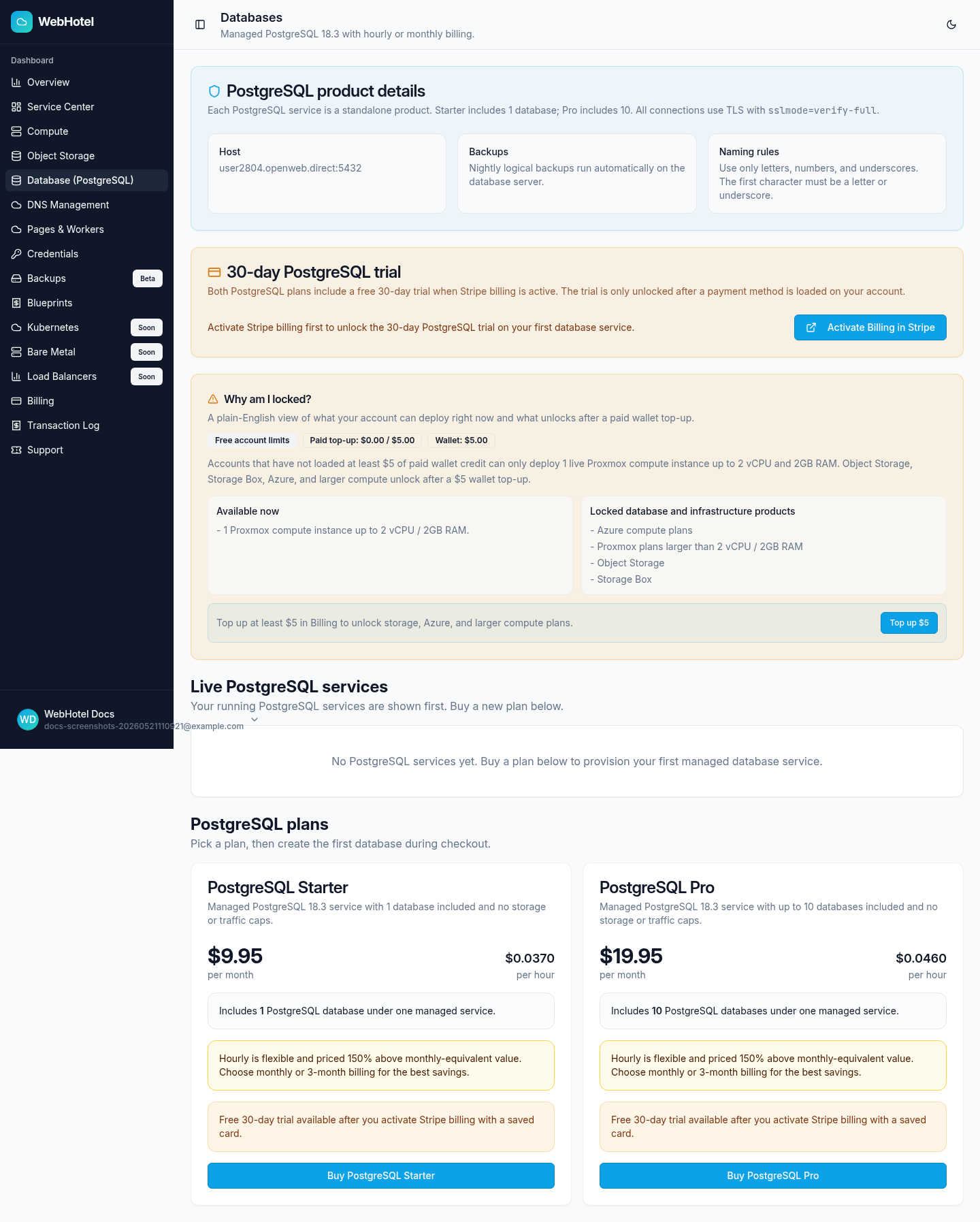
Databases
PostgreSQL plans, trial messaging, and setup guidance.
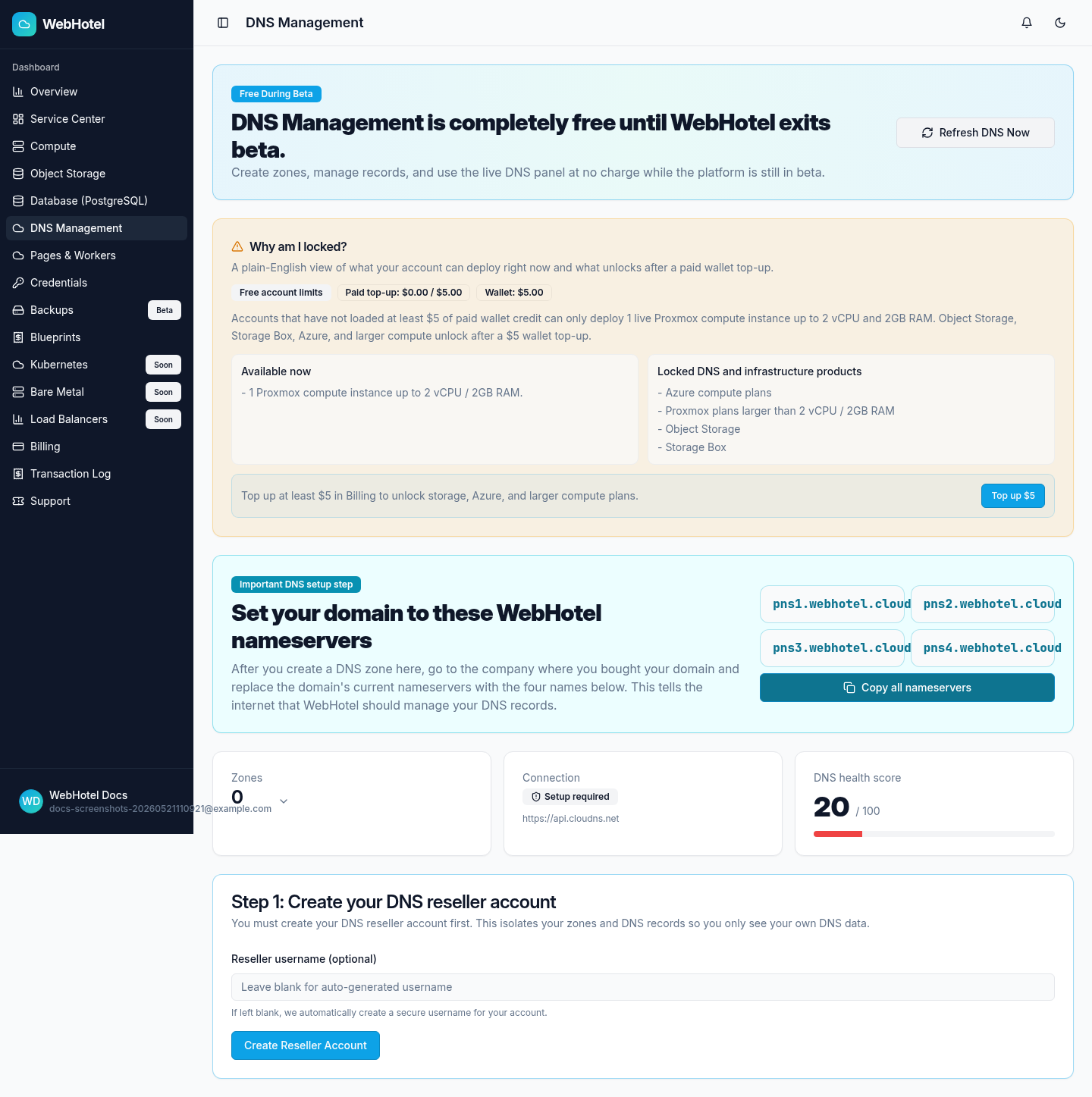
DNS
Free beta DNS, zones, nameservers, records, and propagation controls.
How admins operate WebHotel
Admins use the admin panel to manage users, services, providers, billing, plans, infrastructure health, credentials, content, documentation, SEO, and support. The admin panel is designed to hide upstream provider complexity from customers while still giving staff visibility into the real operational state.
Users and support
- Search by user, email, service name, hostname, IP, VMID, provider ID, or billing variable.
- Open a user profile to inspect wallet, services, tickets, transactions, and timelines.
- Simulate a user to reproduce their exact dashboard experience, then return to admin.
Plans and pricing
- Create and activate plans for compute, object storage, databases, and specialized products.
- Set hourly, monthly, and 3-month options.
- Use provider cost, plan price, margin, and price/TB calculations to protect profitability.
Provider operations
- Manage provider credentials from admin and store them into the environment.
- Use test connection buttons, health panels, audit logs, and restart controls.
- Watch Proxmox, Object Storage, PostgreSQL, DNS, Stripe, and email health.
Service recovery
- Recover failed provisioning, retry deploys, repair SMB mounts, refresh usage, run diagnostics, and inspect provider logs.
- Failed customer provisioning should be refunded automatically and explained clearly.
- Destructive actions use preflight checks and provider health checks before execution.
How WebHotel generates revenue
A simple cloud margin model with recurring expansion.
WebHotel buys or integrates infrastructure capacity from upstream providers and sells it as branded, easier-to-use cloud products. Customers pay WebHotel for convenience, support, unified billing, self-service provisioning, and bundled operational workflows.
- Recurring subscription revenue: monthly and 3-month compute, storage, database, and service plans.
- Hourly usage revenue: flexible compute and storage use at the listed hourly rate.
- Storage expansion revenue: overage charges and upgrades from 1TB to larger plans.
- Wallet breakage and prepaid cashflow: users load credit before usage, improving collection timing.
- Provider margin: admin pricing tools compare upstream cost against WebHotel sell price.
- Customer retention: DNS, databases, storage, blueprints, API, and Windows app make WebHotel sticky.
Future products explained as part of the platform
These services are presented in the product family so users and brokers can understand the complete platform direction.
Kubernetes
Kubernetes gives teams a managed container orchestration layer for deploying apps, APIs, workers, and scalable services with cluster-level controls from the WebHotel dashboard.
Bare Metal
Bare Metal provides dedicated physical server resources for customers who need predictable performance, compliance boundaries, or high-throughput workloads.
Load Balancers
Load Balancers distribute traffic across services so applications can scale horizontally and remain reachable when individual servers are busy or offline.
Common issues and how to explain them
Deploy button disabled
Check required fields, billing mode, deployment-time agreement checkbox, wallet balance, trial restrictions, saved card state, provider health, and password policy.
Provider temporarily unavailable
If an upstream provider returns an API error, WebHotel should remove the failed attempt, refund the charge, and show a modal explaining exactly when to try again.
S3 setup confusion
Confirm endpoint, bucket, access key, secret, path-style mode, and app-specific requirements. Use the exact values shown in the Object Storage setup panel.
PostgreSQL connection fails
Use the exact host, port 5432, database, username, password, and SSL mode shown in the database setup panel.
DNS not resolving yet
Confirm nameservers at the registrar, use propagation checks, wait for DNS caches, and use manual refresh inside the DNS page.
Quick answers
- What is the fastest storage? Ceph NVMe Object Storage on the 10Gbps network.
- What is included in the free trial? One eligible Proxmox service priced at $13/month or less for up to 3 days. Vultr and Azure require paid activation.
- Can a customer pay by card? Yes. Stripe billing can save a card and cover wallet shortfalls where enabled.
- Where do developers go? API documentation is at /api-docs and the OpenAPI spec is at /openapi.json.
Ready to use WebHotel?
Create an account and deploy one eligible server free for 3 days.